Press kit
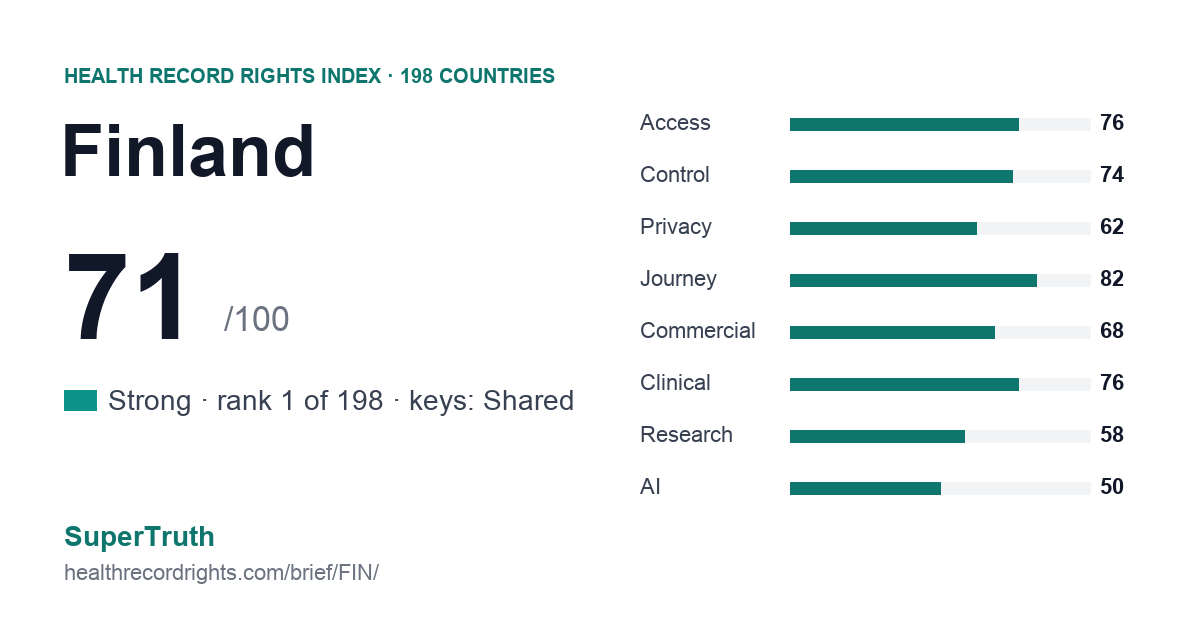
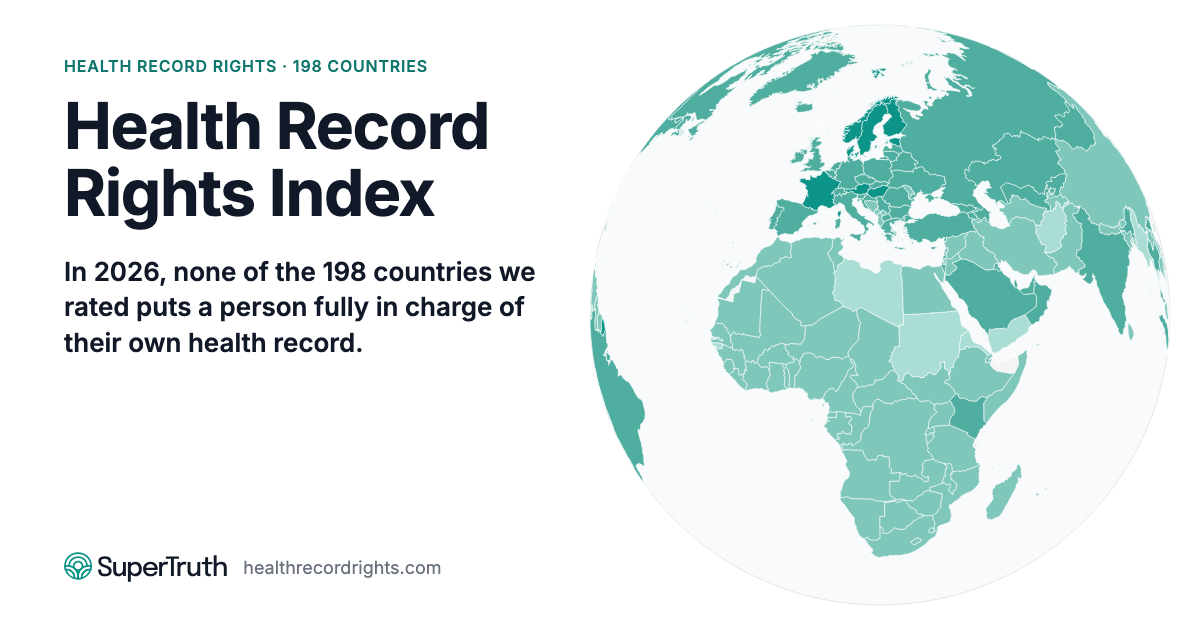
In none of the 198 countries and territories scored in 2026 does the person hold the keys to their own health record. Denmark, Estonia, Finland, Hungary and Sweden lead.
An open index by SuperTruth that scores countries from 0 to 100 on one question: can a person see, control and share their own health record? Data as of October 2, 2026, version 1.0. US state laws read October 3, 2026.
Scores move in steps of about 5 points, so read ranks as ranges. The full method, the audit of our own scores and every source are public.
| Rank | Could rank, allowing for error | Country | Score | Band |
|---|---|---|---|---|
| Lead | 1st to 6th | Finland | 71/100 | Strong |
| Lead | 1st to 8th | Denmark | 70/100 | Strong |
| Lead | 1st to 13th | Estonia | 68/100 | Strong |
| Lead | 1st to 13th | Hungary | 68/100 | Strong |
| Lead | 1st to 17th | Sweden | 67/100 | Strong |
| tied 6th | 2nd to 20th | Australia | 66/100 | Strong |
| tied 6th | 2nd to 20th | France | 66/100 | Strong |
| tied 6th | 2nd to 20th | Norway | 66/100 | Strong |
| 9th | 3rd to 23rd | Austria | 65/100 | Strong |
| 10th | 3rd to 26th | Portugal | 64/100 | Mixed |
Full ranking · Doctors, waits and private care · Real cases
Free to use with credit to SuperTruth. Every country has a share card at /assets/og/ISO3.png (for example /assets/og/FIN.png). For a story page, embed a badge: a small card with a country's score or a state's key answers, which links back to its page and carries the credit.
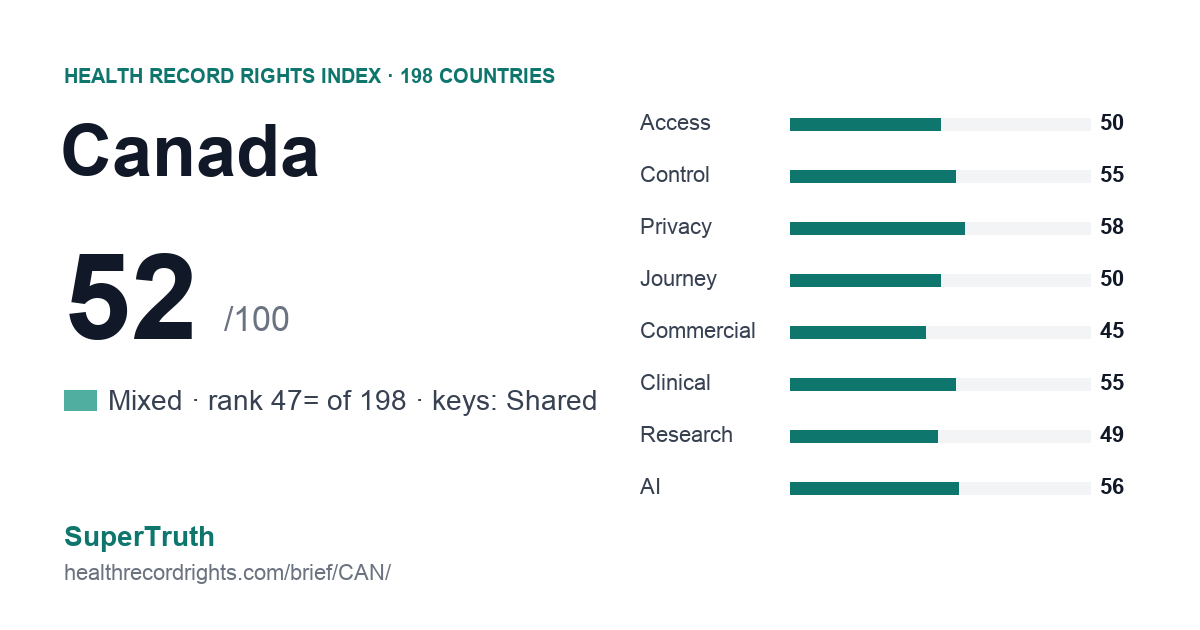
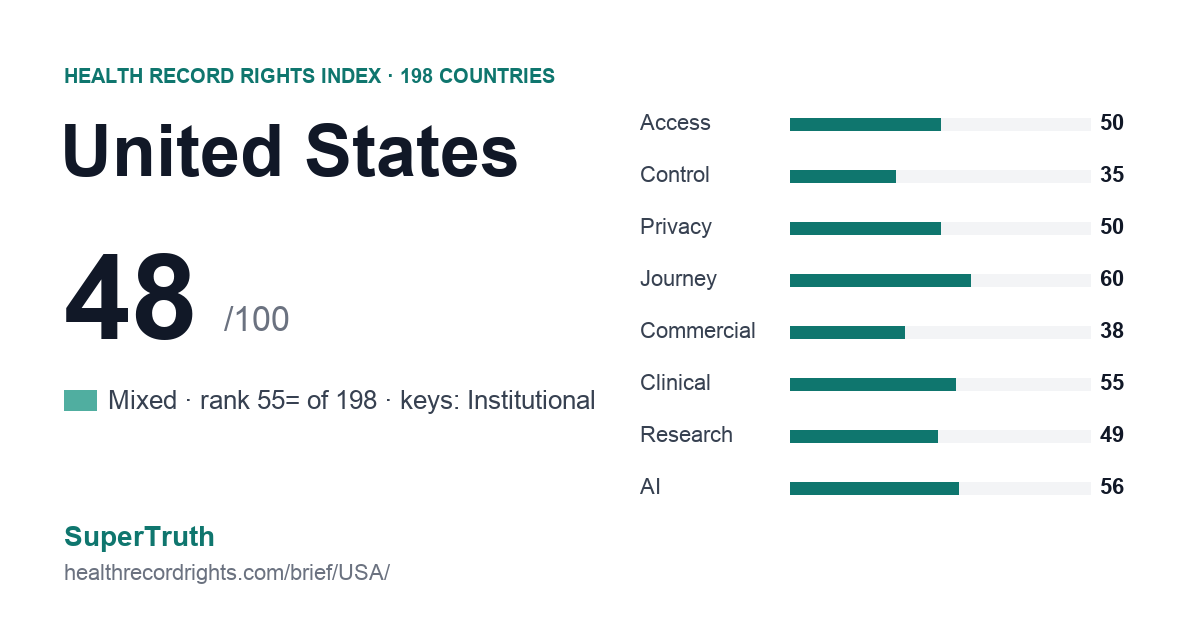
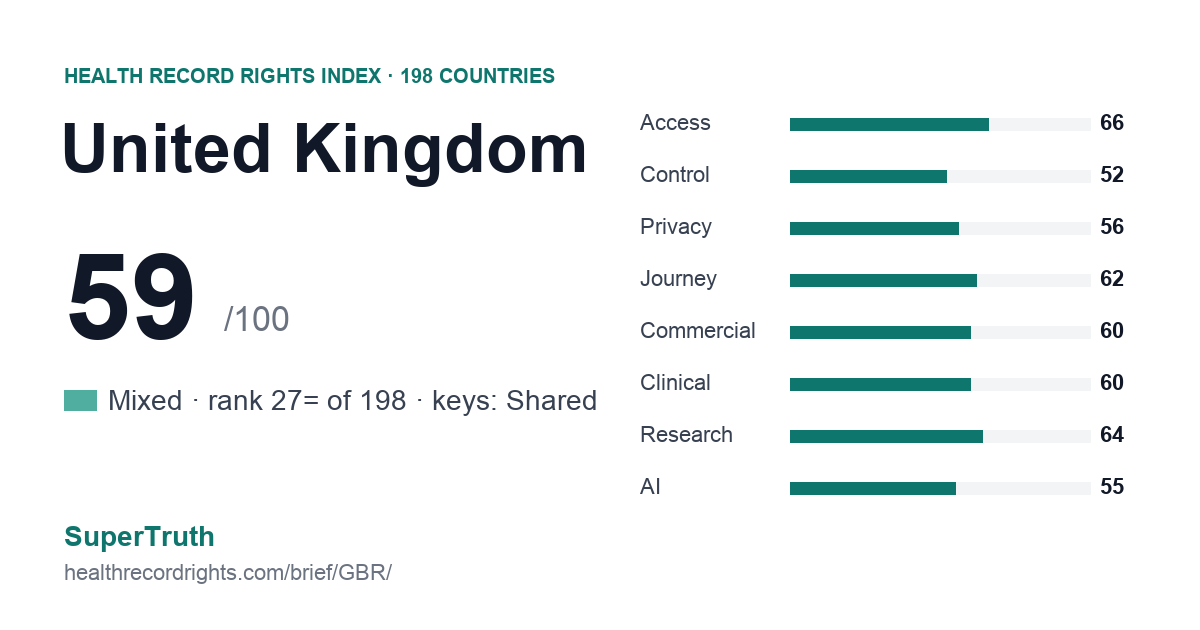
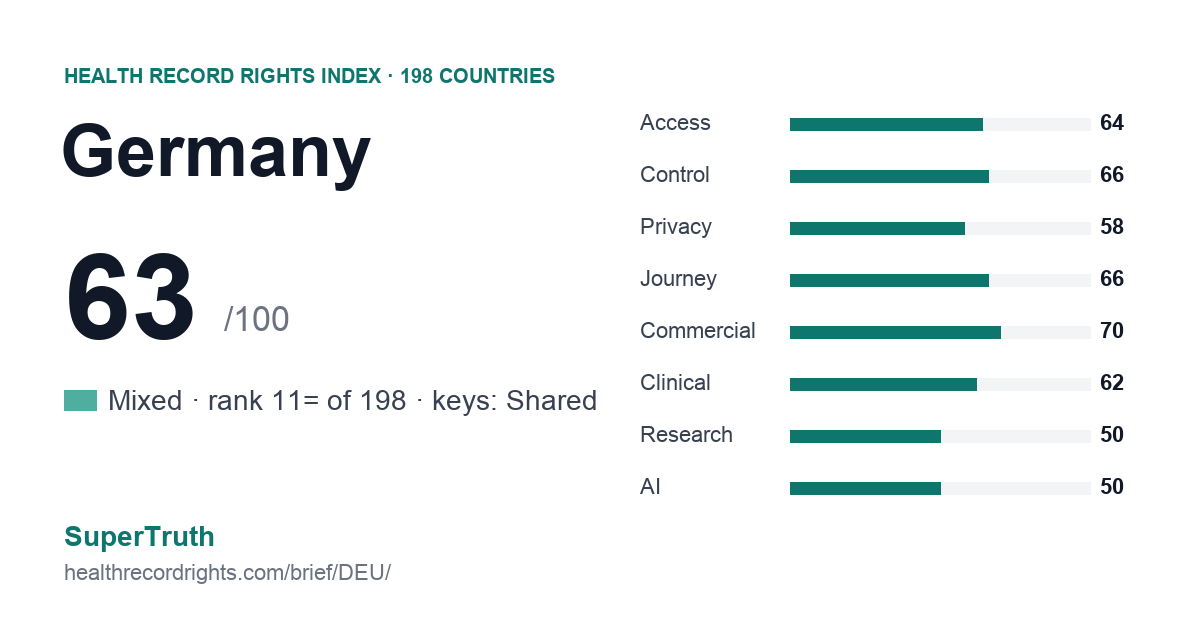
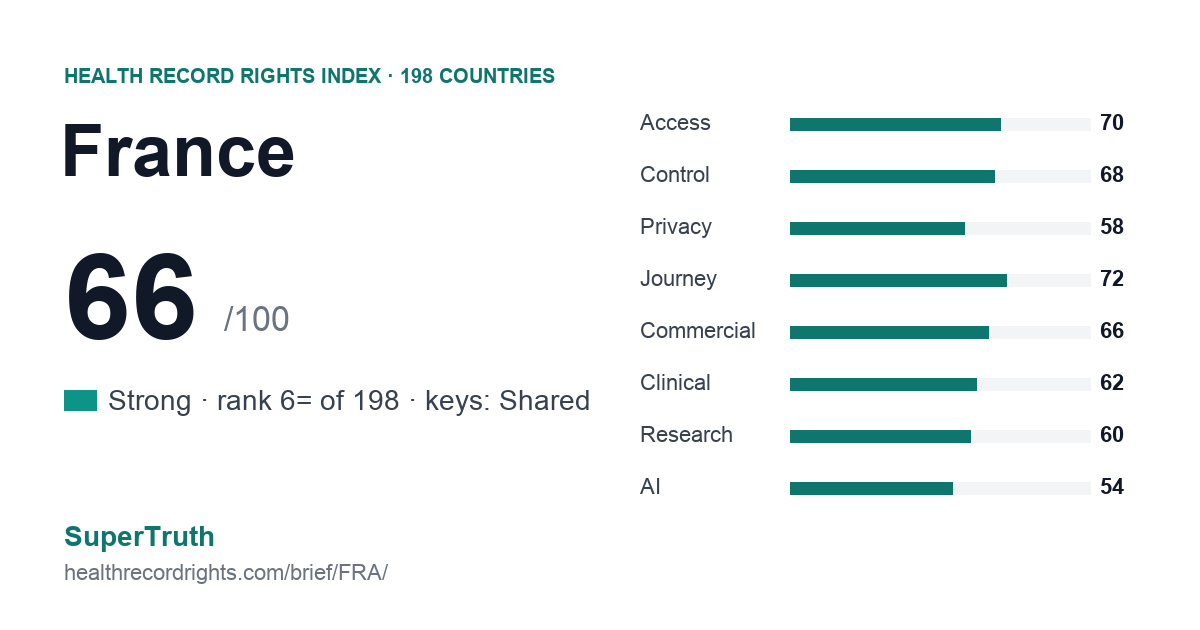
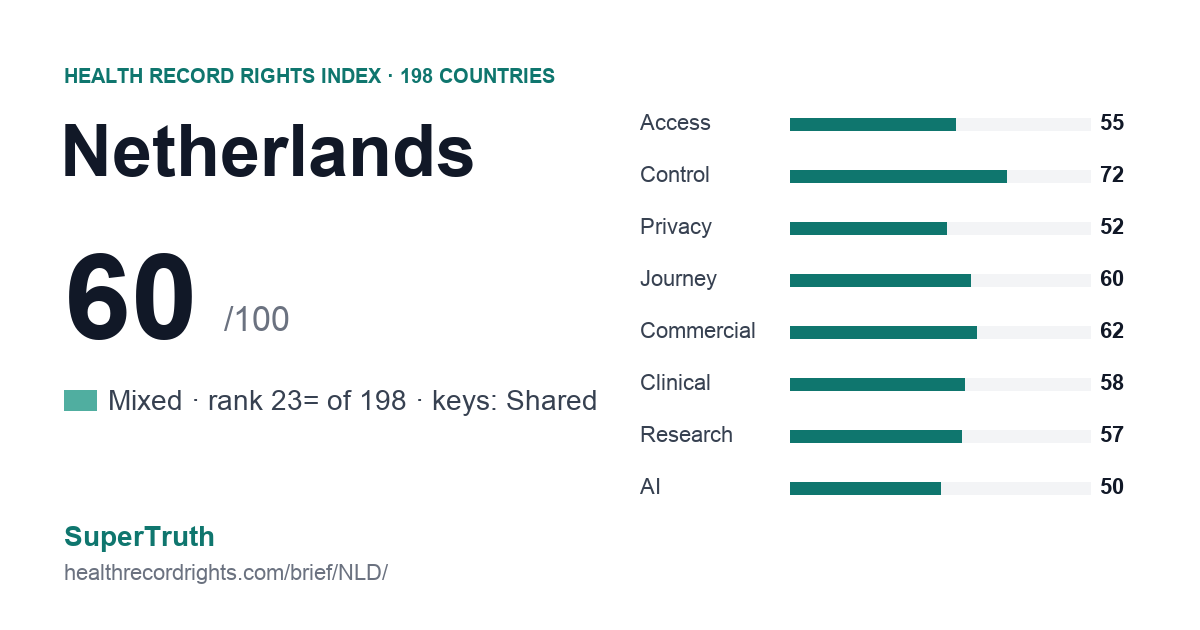
Scores (CSV) · Sources (CSV) · Everything (JSON), under CC BY 4.0 except the quoted words and source titles they contain · data API and MCP server · one-page brief for every country at /brief/canada/
Also indexed in the NLM Dataset Catalog (U.S. National Library of Medicine). The NLM record covers version 1.2 only; the data DOI in the citation below always resolves to the latest data.
Getting your full record and control over who sees it count most: 20 points each, 40 of the 100 together. The overall score is the weighted average of the eight rights.
SuperTruth built the research system behind every score: a written scoring rulebook, AI research agents (built on Anthropic's Claude) that must open and cite every source they use, official sources first, a second agent that checks each country, tests that plant errors to prove those checks catch them, and the authors ruling on every disputed finding. Every score also carries an evidence grade from SuperTruth's proprietary Data Trust Index (DTI™), which rates how far the sources behind it can be trusted; the grade never changes the score. For the countries added after the first version, the agents searched in each country's own languages.
The research uses AI judgment, checked by people. The math does not: once the eight scores are set, the overall score, the band, the confidence label and the evidence grade come from fixed rules and published code, so anyone can rerun them and get the same result.
The checks make errors less likely. They do not rule them out. How we used AI, in full
Every country and territory carries a confidence label for the evidence behind its score. Most, 105 of the 198, carry the medium label.
Confidence counts how many of the 8 rights rest on an official source, like a law, a government or regulator page, or an international agency such as WHO or OECD, with every key fact checked. High: 7 or 8 do. Low: 4 or fewer do. Medium: the rest. The evidence grade (DTI™) rates all the sources we cite, taken together, so a country can cite good sources overall and still have thin evidence on some rights. Both describe our evidence, not the country, and neither changes the score.
The grade rates the sources we cite on things like whether they are official, open to anyone and recent. It does not check that a source says what our summary says. SuperTruth publishes this index and also makes the DTI. How the DTI works.
The Health Record Rights Index scores 198 countries and territories from 0 to 100 on one question: can a person see, control and share their own health record? Eight rights make up the score.
Source: How we scoreGetting your full record and control over who sees it count most: 20 points each, 40 of the 100 together.
Source: How we scoreAI research agents built on Anthropic's Claude did the research. A second agent session checked each country. The authors rule on every audit finding and every proposed score change; a few rulings are still open.
Source: How we used AIIn blind re-scores, agents that could not see our scores came within 10 points (out of 100) of ours on 51 of 58 and 94 of 108 scores for single rights that we sampled. Those agents are built on the same family of Claude models as ours, and no person has re-scored the index.
Source: How we used AIConfidence in the evidence is high for 27 countries and territories, medium for 105 and low for 66. The label describes our evidence, not the country, and never changes a score.
Source: How we scoreIn 28 of the 50 US states, a law in force requires your OK before at least some apps or other businesses outside HIPAA use or share your health data. We found no such law in force in Washington, DC.
Source: What your state adds to HIPAASuperTruth is a data truth company. Before an AI model acts on a record, a place, or another agent, we prove it.
It works in three parts. DTI™ is our patented trust score: 0 to 100, across eight dimensions, on any record. DataSpine is our sourced map of every place in the U.S.: tens of millions of data points, each with its source and vintage. VIGIL scores the AI agents that use that data and locks the result in a hash-chained ledger nobody can quietly edit.
We started in health because a wrong record there costs the most. The same proof works in finance, media, and anywhere you trust a machine to act.
SuperTruth: Data truth is AI truth.
Three of the authors, Jason Alan Snyder, Robert P. Hill IV and Dustin Raney, are officers of SuperTruth Inc., which sells health data verification products. The fourth, Leann Sims, is Chief Executive Officer of MedSync, a US health information exchange that works with SuperTruth. The evidence grade adapts SuperTruth's own Data Trust Index; its source is the first author's own paper and has not been peer reviewed. SuperTruth funded this work and controlled its design, analysis, writing and the decision to publish. SuperTruth built this index and chose the real cases itself; no country, company or person paid to be included, excluded or scored. imaware, an affiliate of SuperTruth, provides testing services under agreements with some US state governments. The index scores the United States as one country and does not score any state separately; no government or health system paid to be included or had any say in its scores. The state layer asks about consent for health information exchange; it records the exchange a state names, where there is one, but scores no exchange and does not name MedSync. No author or reviewer outside SuperTruth and MedSync took part.
Built by SuperTruth, which checks whether a record can be trusted before an AI acts on it. About SuperTruth · How we used AI · Follow changes